This year has seen a remarkable increase in the recognition and promotion of Jewish cultural heritage in the Aube department and the Grand Est region as a whole. Here’s our interview with Delphine Yagüe, director of the Public Interest Group ‘Rachi – Troyes and the Aube in Grand Est’ (GIP Rachi), on the award of the European Heritage Label to ‘Rachi of Troyes, a European place of remembrance’.
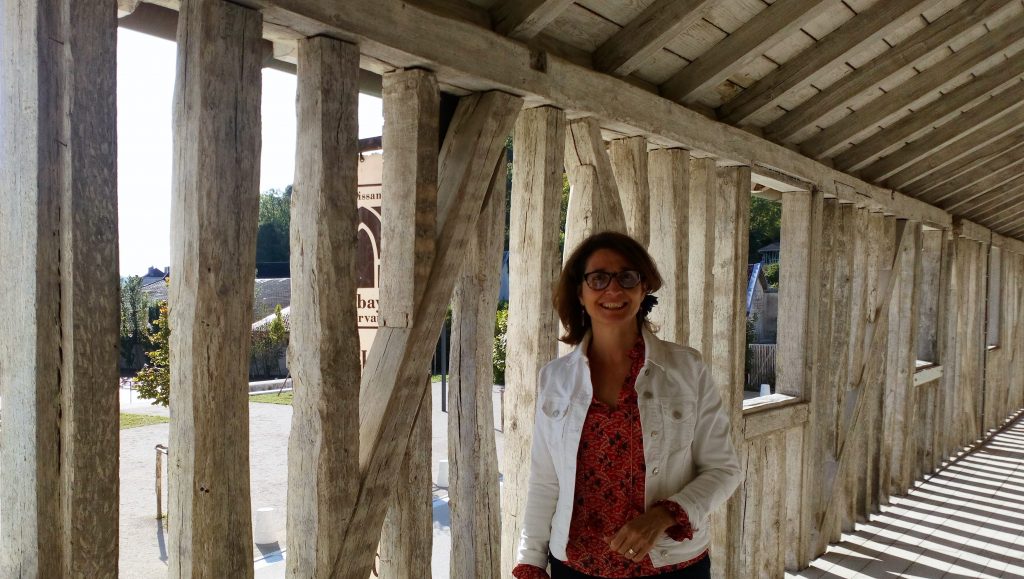
Jguideeurope: First of all, could you tell us about the European Heritage Label?
Delphine Yagüe : The European Heritage Label recognises sites that have played a major role in the history, culture and integration of Europe. Created in 2005 and supported by the European Union, it does not merely recognise a site’s heritage value: above all, it acknowledges its symbolic significance and its ability to help people understand what unites Europeans through their shared history.
This label has three main objectives. It aims to raise awareness of the history of Europe and the European integration process, to make citizens more aware of the European dimension of heritage sites, and to promote intercultural dialogue, particularly through educational, cultural and artistic initiatives.
The award of this label to ‘Rachi of Troyes, a European site of remembrance’ is a significant honour. Our site joins a network of 67 labelled sites across Europe, alongside twelve new recipients. In France, it joins five sites that have already been awarded the label: the Robert Schuman House in Scy-Chazelles, Cluny Abbey, the European Quarter in Strasbourg, the former Natzweiler concentration camp and its satellite camps, and the Chambon-sur-Lignon Memorial Site.

How did the application for the European Heritage Label proceed?
This application is the result of a collective effort that began with the creation of the GIP ‘Rachi – Troyes and the Aube in Grand Est’ on 30 June 2023. Bringing together the State, the Grand Est Region, the Aube Departmental Council, the City of Troyes and the Central Consistory, the GIP’s mission was to prepare and submit the application for ‘Rachi of Troyes, a European memorial site’ for the European Heritage Label. Our aim was to secure recognition for the exceptional contribution made by Rachi and his school of thought, the Tossafists, to the development of a European culture and identity from the Middle Ages onwards.
After several months of preparation, our application was selected by the French jury. It became the sole French nomination forwarded by the Ministry of Culture to the European Commission on 28 February 2025. It was subsequently shortlisted amongst 21 European sites in the running for the 2025 award.
The nomination currently highlights a coherent group of six iconic sites: the former Jewish quarter of Troyes, the Rachi European University and Cultural Institute, the Maison Rachi, and the three murals of the ‘Parcours Rachi’ located in Dampierre, Ramerupt and Lhuître. Beyond these sites, the application sets out an ambitious programme of scientific, cultural, tourist, educational and artistic projects designed to bring this heritage to life on a European scale.
Following an assessment carried out by an independent jury appointed by the European Union, the European Heritage Label was awarded to the project ‘Rachi of Troyes, a European Place of Remembrance’ on 25 February 2026. This recognition affirms both the universal value of Rachi’s heritage and the commitment of all the partners who supported this application.
What opportunities does being awarded the European Heritage Label open up?
Being awarded the European Heritage Label marks a new stage in the promotion of Rachi’s heritage. Firstly, it will help to strengthen the links between the six sites and offer visitors a coherent narrative journey, tracing Rachi’s life, work and European influence.
This work is part of an initiative that has been underway for over thirty years, led by the local authorities and the Jewish community of Troyes. It has resulted in the creation of major venues and educational resources: the Rachi Institute and the ‘Sphère Rachi’ in 1989, the Rachi House in 2017, followed by the Medieval Rachi Trail in Champagne in 2019 and the ‘Parcours Rachi’ in 2022. These sites already play a vital role through their scientific, educational, cultural and tourist activities.
The label will now take this initiative to a new level. It will facilitate Rachi’s integration into major European heritage networks and the development of joint projects with other sites holding the European Heritage Label. These collaborations will enable the sharing of experiences, the development of cultural and educational initiatives on a European scale, and the reaching of a wider audience.