From 1670 onwards, for 250 years, the region was home to one of the most important centres of Jewish culture in Central Europe. The Austrian Jewish Museum is one of the contemporary reflections of this artistic splendour… Here’s our interview with Dr Esther Heiss, the museum’s director.
Jguideeurope: Do you think that ‘Love’, the theme chosen this year for the European Days of Jewish Culture, represents a form of hope for a tikkun olam?
Dr Esther Heiss: Love is always the foundation of Tikkun Olam. For why else would anyone seek to heal the world, if not out of love for it and for the people who live on it? In this sense, love is not merely the hope for Tikkun, but its precondition. Even if world events do not always make it easy to love humanity, with all its flaws and imperfections.
What events are being organised for the European Days of Jewish Culture?
On the 6th of September at 11:00 am, the Austrian Jewish Museum will present the documentary film ‘Das Vermächtnis des Oberrabbiners Adolf Altmann’ (‘The Legacy of Chief Rabbi Adolf Altmann’) by Ralf Kotschka, which was produced in Trier in 2024.
As an Austro-Hungarian rabbi, Dr Adolf Altmann had helped to establish the Salzburg community before the First World War and became known for his two-volume work ‘The History of the Jews of Salzburg’. During the war, he served as a field rabbi in the Austro-Hungarian army. In 1919, the rabbi left Salzburg and Merano to become the new Chief Rabbi of the Trier Rabbinical District, where he served for 18 years until his forced flight in April 1938. His subsequent journey led him inevitably from the Netherlands to Auschwitz, where he died in 1944. His wife Malvine, formerly Weiß, was murdered in the gas chambers. Two of his sons survived the Shoah by fleeing to England just in time.
After many years of research, Ralf Kotschka managed to track down a gramophone record featuring the voice of Rabbi Altmann. It is a kind of legacy, for that record contains a message from Rabbi Altmann in exile to the Jewish people, recorded just before the outbreak of war using the technology of the time. With the screening of the film at the Austrian Jewish Museum, Rabbi Altmann’s voice will be heard in Austria for the first time since 1919.
Can you share a fond memory from a previous edition?
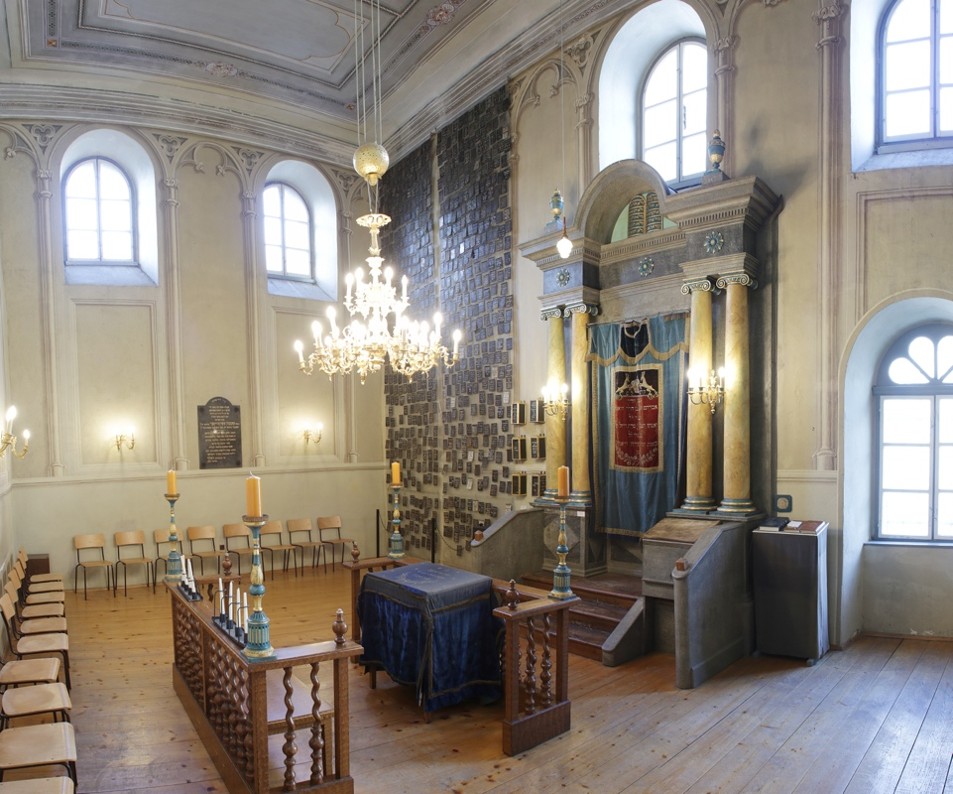
I was showing a man around our synagogue, which is the oldest active synagogue in entire Austria, and was just explaining to him the importance of the Torah when he mentioned that his grandmother, who was Jewish, had once told him the same thing. I asked him if he was Jewish; he replied with complete conviction that no, he was Catholic. I wasn’t quite as sure as he was, so I asked him whether his grandmother had also had a daughter. He said yes, that would be his mother. He was standing in the glow of the Torah ark and in front of the Torah scroll, wearing a kippah, when I told him, ‘Congratulations, your grandmother, your mother and, yes, that means you too are Jewish.’ Whether he accepted it or not, at that moment he was moved by a past that almost no one in his family remembered anymore.
Do you organise any other cultural events in autumn and winter?
Yes, we do. We offer our visitors a wide range of cultural and artistic events. For example, in collaboration with the Schuberttheater, we are presenting a puppet show about Hedy Lamarr, the most beautiful woman in the world. We are taking part in the Long Night of Museums, during which two exhibitions featuring international artists will be on display here. We will be screening a film about the internationally successful artist Soshana and holding a reading of ‘Der Partisan im Frieden’. This will be followed in November and December by two concerts, featuring Yiddish songs, to name but one. The final concert of the year is our traditional Hanukkah concert, which our guests particularly look forward to. All our events can be found on the Austrian Jewish Museum’s website, www.ojm.at.