Aleja Pamieci Ofiar Litzmannstadt Getto 12, 91 859 Lodz Tel: +48 42 291 36 27
Plus d'infosSite
Site
Aleja Pamieci Ofiar Litzmannstadt Getto 12, 91 859 Lodz Tel: +48 42 291 36 27
Plus d'infosRégion
The first Jews probably settled in Mir in the 17th century. On the eve of the Second World War, 2400 members of the community lived there, half of the city’s population. A famous Lithuanian yeshiva participated in the influence of this city for the Jews of Europe. All of Mir’s Jews were murdered by bullets, except 200 who escaped the day before the last German shooting in August ...
Plus d'infosRégion
In 1610, the city fathers of Rotterdam issued permits to engage in trade within the city to a small number of Portuguese Jewish merchants. The permits guaranteed freedom of worship and the right to build a synagogue and establish a cemetery. In 1612, these provisions were challenged by the local Remonstrant Church. This prompted a number of Jewish families to depart Rotterdam for Amsterdam. ...
Plus d'infosRégion
Several Jewish families settled in Veghel during the 18th century (around 1731) despite the opposition of local authorities. Most of the Jews who settled in Veghel came to the village from nearby Nistelrode or Dinther. During the second quarter of the 19th century, an organized Jewish community was established in Veghel. The community at Veghel opened a synagogue on the Achterdijk, the ...
Plus d'infosSite
Zentralstraße 4, 04109 Leipzig
Plus d'infosRégion
A Jewish community is first mentioned in Leipzig at the end of the 12th century; and an organized community with a synagogue and a school existed from the second quarter of the 13th century. Its central location attracted Jewish traders from all over Europe to the Trade Fair. The fair regulations of Leipzig of 1268 guaranteed protection to all merchants and moved the day of the market from ...
Plus d'infosSite
Via Giacomo Matteotti, 40129 Bologna
Plus d'infosRégion
The terrifying war against Ukraine changes, of course, the function of these pages devoted to the Jewish cultural heritage of that country. Many of the places mentioned were razed to the ground by bombs. While these pages are not intended in the present time for tourism, they may be useful to researchers and students as historical references. References to so many painful histories during the ...
Plus d'infosSite
Central Ave, 288, Mykolaiv, Mykolaivs’ka oblast, Ukraine, 54000
Plus d'infosRégion
Following the angry reception that greeted him when he preached to the Jews of Thessaloniki, around the year 50, the Apostle Paul was spirited out of town by fellow believers in Jesus’ reincarnation. They brought him to Berea, some 60 km to the west. There too, Paul spoke in a synagogue, but in Berea the Jews “were more noble than those in Thessaloniki, for they received the word ...
Plus d'infosRégion
On 23 February 2008, the Compiègne Internment and Deportation Memorial was inaugurated on the site of the former Royallieu camp in Compiègne. Since then, 90,000 visitors have crossed the threshold of this place of history and remembrance. The Royallieu barracks were built in 1913 and comprise 25 buildings covering an area of 16 hectares. From 1941 to 1944, it was transformed by the German ...
Plus d'infosRégion
The Jewish presence in Ingwiller seems to date from 1347, the date of an administrative document attesting to this. Under the regency of the Counts of Hanau-Lichtenberg, they enjoyed greater individual and economic freedom than many other towns in the region. The Jewish community grew throughout the 18th century, from 13 families in 1716 to 25 in 1766. The development of spiritual life ...
Plus d'infosRégion
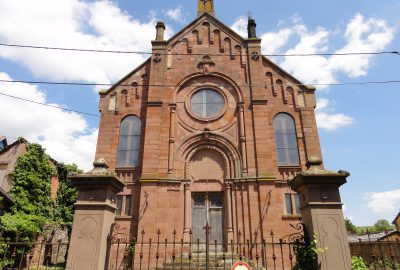
The Jewish presence in Hochfelden seems to date from the 16th century. Built in 1841 and a historical monument since 1996, the of Hochfelden is a classic example of Alsatian synagogue architecture. It was preceded and even accompanied by another synagogue, built in the 17th century. Next to the synagogue was a mikveh, the former rabbi’s house and a Jewish school. The synagogue was ...
Plus d'infosRégion
Haguenau is one of the oldest Jewish communities in Alsace. The Jews lived there almost without interruption since the Middle Ages, probably in the 12th century, and enjoyed the same freedoms as the other inhabitants, except for a few episodes, mainly of a more national scope, affecting all regions. The first synagogue was confiscated during the expulsion of 1349. Upon their return, the ...
Plus d'infosRégion
The Jewish presence in the villages surrounding Haguenau seems to date at least from the 14th century. In Ettendorf in particular, two Jewish families are recorded in administrative documents in 1449. In the Middle Ages, Ettendorf was home to a large Jewish community and many scholars who came to study in its famous rabbinical school, sometimes with more than a hundred students. Ettendorf is ...
Plus d'infosRégion
The Jews of Erstein were not allowed to settle in the city until 1850. Some were allowed to work there during the day, but had to return in the evening to the towns in the region that were more open to Jewish emancipation. The was inaugurated in 1882. It was destroyed in April 1941 by the Nazis, its contents auctioned off at that time. Of the 100 Jews living in Erstein in 1939, only 60 were ...
Plus d'infosRégion
The Jewish presence in Diemeringen seems to date from the 17th century. Only 14 Jewish families lived there on the eve of the French Revolution. The community of Diemeringen was organized – synagogue, religious school and mikveh – around the rue des Juifs (today rue du Vin). The community grew mainly in the 19th century, reaching 139 people in 1870. The war, and then the rural ...
Plus d'infosRégion
The Jewish community of Dambach-la-Ville dates back to the seventeenth century and so is the synagogue which was renovated in 1850. After the community disappeared, it was donated to the town in 1947 and transformed into a theatre. Renovation work, including the installation of an air conditioning system, led to the discovery in 2012 of a formidable treasure: a genizah (a ...
Plus d'infosRégion
The first mention of a Jewish family in Brumath dates back to 1562. Documents from the end of the century mention the presence of a Jew named Susskind. In 1693, 4 Jewish families were registered in Brumath and, in 1766, their number rose to 9. The French Revolution gave Brumath, as in the rest of the country, access to citizenship for Jews. This allowed the Jewish community not only to settle ...
Plus d'infosRégion
The Jewish presence in Benfeld dates back from the Roman Empire. During the Middle Ages, the community was lively and as important as the one in Strasbourg. The Jews were expelled from the city during the 1349 black plague, then drawn or burned on the same year during the Saint Valentin massacre. From this date, Benfeld was forbidden to Jews until the eighteenth century. The community ...
Plus d'infosRégion
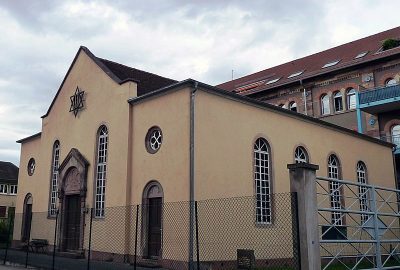
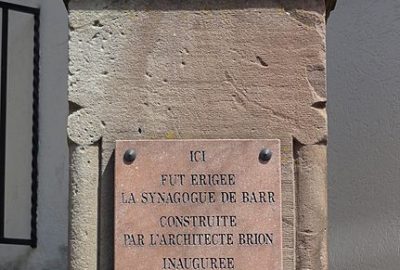
Banned from the communes attached to the bishopric of Strasbourg until the French Revolution, the Jews made a timid return to the region afterwards. Of the 800 Jews present in the surrounding villages in 1784, there were none in the town of Barr. Nevertheless, the town gradually welcomed Jews, mainly from Zellwiller, allowing a community to take shape in the second half of the 19th century. ...
Plus d'infosRégion
The Jewish community of Balbronn is registered in the censuses of the city since 1665. Some medieval houses of the city center still bear the traces of mezuzot. is located 47-48 Balbach street, in what is commonly called “House of the Jews”. The house dates from 1638, although it started serving as a synagogue only in 1730. The prayer hall was on the ...
Plus d'infosRégion
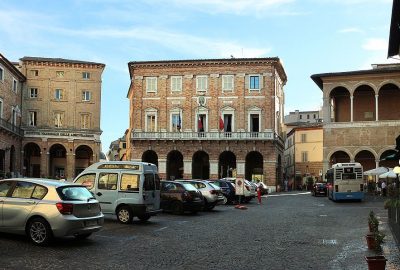
There are little remaining traces of the Jewish presence in Macerata. You can nevertheless visit the which contains archives mentioning the presence of a Jewish community in the city since 1287. houses a tombstone with an Hebrew inscription from 1553, referring to the passing of Rabbi Avigdor. The tombstone was probably transferred here from the old Jewish cemetery of Cappuccini Vecchi. The ...
Plus d'infosRégion
Rakovnik is located between Prague and Plzen; 32 miles west of Prague, and 30 miles northeast of Plzen. Jews are on record as living in Rakovnik since 1441. Between 1618 and 1621, three Jewish families from the nearby town of Senomaty came to live at Rakovnik. In 1690, there were 38 Jews living in the town, and in 1724, seven Jewish families had made Rakovnik their home. The Jewish community ...
Plus d'infosRégion
The Jewish presence in Breclav dates to the sixteenth century. The ghetto, constructed in the seventeenth century, can still be visited. The neo-Roman style synagogue was built in 1888. Closed by the Nazis, it served as a warehouse for a half century. The synagogue today houses a cultural center, an exhibition hall, and an auditorium. In 2000, a plaque was affixed in the synagogue’s ...
Plus d'infosRégion
Polná is located in Bohemia, about 70 miles south-west of Prague. Jews started settling in Polná in the fifteenth century. The ghetto was created in the seventeenth century, some houses can still be seen. The synagogue was built in 1682. Destroyed by a fire, it was restored in the nineteenth century. It served as a place for worship until 1936, then was used as a store for confiscated Jewish ...
Plus d'infosSite
Site
Site
Str. Ion Brezoianu/Str. Ilfov
Plus d'infosSite
Stacja Kolejowa Sobibór 1, Włodawa Tel: +48 82 571 98 67
Plus d'infos